
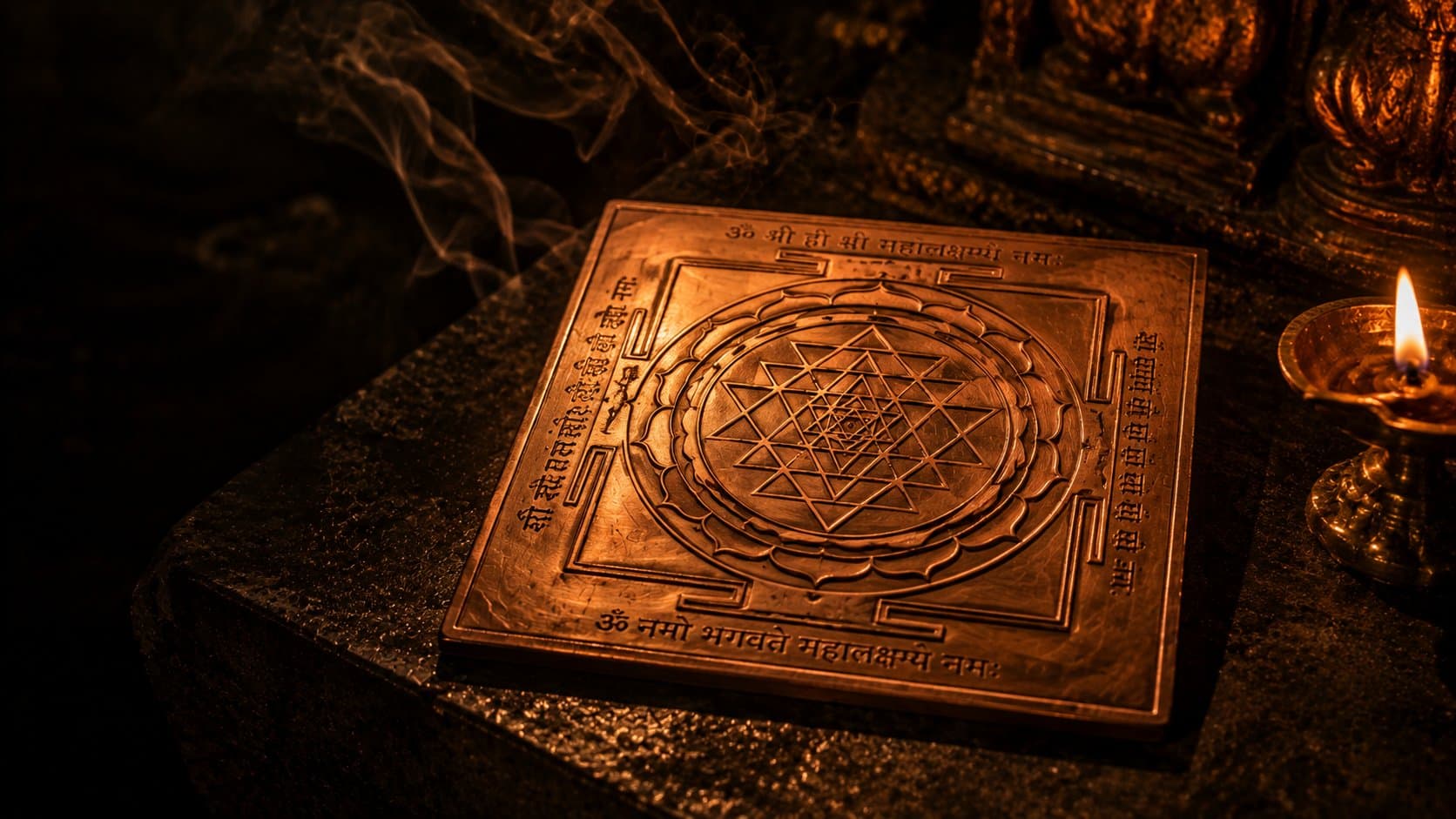
Sri Yantra (Sri Chakra)
The Panchadashakshari (15-syllable) mantra traditionally paired with this yantra is treated in Shri Vidya practice as initiatory — transmitted by a guru, not casually published — so it is deliberately not printed here.
The interlocking upward triangles represent Shiva, the downward triangles represent Shakti; together the yantra symbolizes the union of consciousness and energy, and the totality of creation.
The central object of meditation and daily puja within Shri Vidya practice, considered the "yantra form" of the goddess — paired with her mantra and her iconographic image as three parallel expressions of the same deity.
Ganesha Yantra (Ganapati Yantra)
Invoked for the removal of obstacles, wisdom, and auspicious new beginnings.
Home or workplace altar, ideally facing east or north; commonly placed near the main door; avoided in bedrooms/bathrooms.
ॐ गं गणपतये नमः
Om Gam Ganapataye Namaha
The standard beeja (seed) mantra for Ganesha, sourced from the Ganapati Atharvashirsha. A second commonly cited mantra for the specific "Vakratunda" form is "Om Vakratundaya Hum."
Kuber Yantra
Sources show two genuinely attested mantras for Kubera — a short namaha-form and a longer traditional invocation. Both are presented below rather than silently picking one.
Used to invoke stability and growth of wealth and prosperity.
North or northeast area of the home, on a clean, elevated surface/altar.
ॐ यक्षाय कुबेराय वैश्रवणाय धनधान्याधिपतये धनधान्यसमृद्धिं मे देहि दापय स्वाहा
Om Yakshaya Kuberaya Vaishravanaya Dhana Dhanyadi Pataye Dhana Dhanyadi Samruddhim Me Dehi Dapaya Swaha
The longer, more consistently documented traditional invocation across ritual-focused sources.
ॐ शं कुबेराय नमः
Om Sham Kuberaya Namah
A short namaha-form given in the Agni Purana tradition (per Wikipedia).
Navagraha Yantra
There is no single universal mantra for this yantra — tradition instead pairs each of the nine grahas with its own individual mantra, typically chanted on that planet's associated weekday. Presenting one composite mantra here would misrepresent the practice, so none is given.
Represents all nine grahas together, used to harmonize planetary influences and mitigate malefic effects (doshas) from any of the nine.
Each of the nine grahas has its own mantra, conventionally chanted on its associated weekday (e.g. the Surya mantra on Sunday, the Chandra/Soma mantra on Monday, and so on).
Talk to a Verified Astrologer
Get personalized, 1-on-1 guidance beyond what any calculator can tell you.
Book a Consultation