
Understanding the Navamsa (D9) Chart
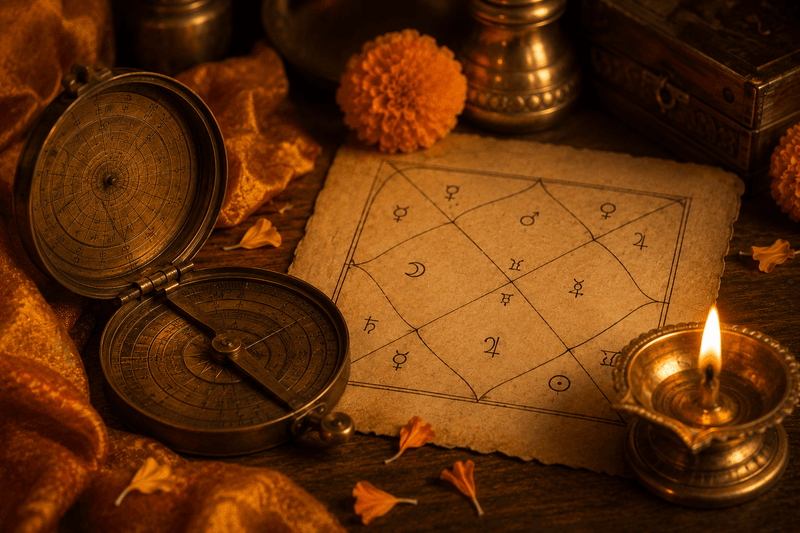
Alongside your main birth chart (the D1, or Rashi chart), Vedic astrology uses a set of divisional charts (Vargas) that zoom into specific life areas. Of all of them, the Navamsa (D9) is considered the single most important — this is what it actually shows.
What "D9" Means
Each sign in your main chart is divided into 9 equal parts (each spanning 3°20'), called Navamsas. Where a planet falls within its sign determines which Navamsa sign it's assigned to in the D9 chart — a separate, full 12-house chart built entirely from these subdivisions, laid over your original planetary positions.
Why It's Checked for Marriage
The D9 is traditionally read as the chart of marriage, partnership, and the second half of life's inner strength. A planet that looks weak in the D1 but is well-placed in the D9 (called Vargottama when it lands in the same sign in both charts) is generally considered to regain much of its strength — a distinction Ashtakoot Guna Milan alone doesn't capture.
Spiritual and Character Strength
Beyond marriage, the Navamsa is also read as a chart of inner resilience and dharma — how a person holds up under pressure, independent of the more visible, outward-facing D1. Some classical texts describe the D1 as the tree and the D9 as the fruit: the main chart shows the visible structure of a life, the Navamsa shows what it's actually built on.
Reading It Alongside, Not Instead Of, the D1
The Navamsa is never meant to replace the main chart — it's a second lens applied on top of it. A planet strong in both D1 and D9 is read very differently from one strong in only one of the two. Our Kundli tool generates your D9 alongside your D1 and every other divisional chart automatically, so you can compare them side by side rather than reading either one in isolation.